How to build a new home in Adelaide
A new home is the largest commitment most families make. Here is the framework for choosing between house-and-land, semi-custom and custom paths, sequencing land and builder decisions, and understanding the finance and consent journey.

A new home is the largest commitment most families make. Here is the framework for choosing between house-and-land, semi-custom and custom paths, sequencing land and builder decisions, and understanding the finance and consent journey.
The 10-step framework
- STEP 1
Choose the right build model
Three broad paths: house and land packages (land plus a chosen design bundled by one builder, fastest and simplest, limited customisation), semi-custom (choose your own block, choose a builder with a design range and modify to suit, most common middle path), and full custom (architect-designed or building-designer-led bespoke home built by a custom builder). Cost, timeline and flexibility increase left to right. Match the model to your budget and design ambition.
- STEP 2
Sequence the land and builder decisions
For house and land packages, land and builder are chosen together in one transaction. For custom or semi-custom, land is typically chosen first, then builder engaged after zoning, orientation and site conditions are confirmed. Buying land without checking whether your target design fits is a common early mistake. See the choosing-land pillar for the full land framework.
- STEP 3
Confirm finance capacity before signing
A construction loan is different from a standard home loan: progress payments released against milestones (deposit, slab, frame, lockup, fixing, practical completion), interest only during construction, converts to standard mortgage at handover. Get pre-approval from a broker or lender before committing to land or a build contract. Serviceability testing includes projected repayments post-construction, not just during.
- STEP 4
Understand the concessions available
First-home buyers in SA have access to First Home Owner Grant, first-home stamp duty concessions, and HomeStart Finance loans. Owner-occupier buyers may qualify for other RevenueSA concessions. Investment buyers do not typically qualify for these. See the first-home-builders pillar for the FHOG framework. Confirm current rules on revenuesa.sa.gov.au.
- STEP 5
Understand the consent journey
A new home requires both planning consent (does the design comply with the Planning and Design Code and any overlays) and building consent (does the design meet the National Construction Code). Some estates offer complying development for planning consent, which speeds up the process. Others require full merit assessment. Timelines: complying 5 business days, merit assessment 4 to 12 weeks depending on notification.
- STEP 6
Read the contract in detail
Residential building contracts in SA are typically HIA, MBA or bespoke builder forms. Key clauses to check: fixed price scope and Prime Cost items, provisional sum items, variation process, delay events and liquidated damages, defect liability period, warranty, dispute resolution and payment schedule. Engage a building lawyer for contract review before signing. See the building-contracts and building-lawyers pillars.
- STEP 7
Verify licensing and insurance
Every SA builder must hold a current Building Work Contractors licence from Consumer and Business Services SA. Every project must be covered by Home Indemnity Insurance to protect against builder insolvency, death or disappearance. Ask for the licence number and Home Indemnity certificate specific to your project before signing.
- STEP 8
Plan for the site cost estimate
The base contract price is for a standard slab on a straightforward block. Site cost estimates cover: earthworks, retaining walls, footings sized for the soil, connections and stormwater. On a difficult block, site costs can be tens of thousands above the base contract. Get a site-specific estimate before signing.
- STEP 9
Talk to at least three recent clients
Ask each shortlisted builder for contact details for three homeowners who took handover in the last 12 months. Call them and ask the six standard reference questions from the compare-builders pillar. A builder who cannot or will not provide references is self-selecting out.
- STEP 10
Plan the handover and defect period
At practical completion the builder hands over the home for occupancy. A defect liability period follows (typically 90 to 180 days) during which the builder remediates non-structural defects raised by the owner. Structural defects are covered by statutory warranty. Do a thorough handover inspection; consider a private inspector to catch defects the average owner would miss.
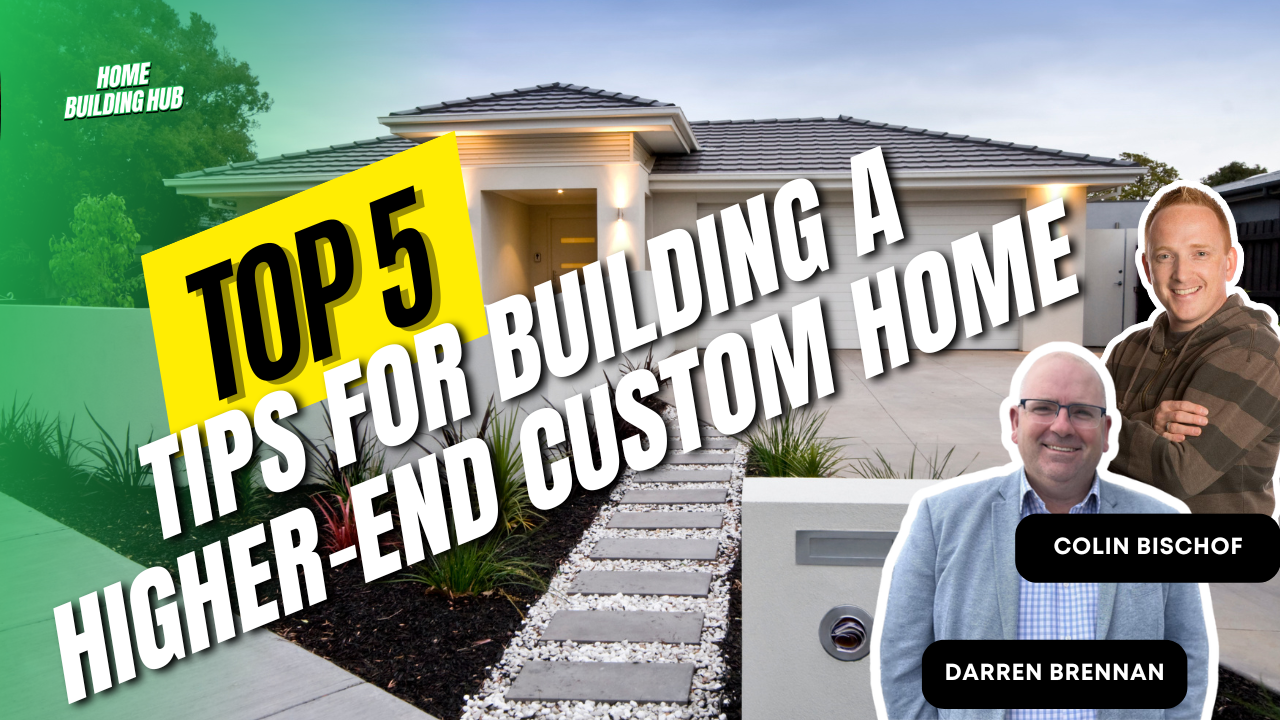

Building a higher-end custom home is about more than great design. We share five expert tips to help you choose the right team, manage your budget and avoid costly mistakes before construction even begins.
Watch full episodeWant this as a printable?
We'll email you the full 10-step framework, formatted for printing and ready to take into your next site visit or quote meeting.
FAQs
Related BuildPilot guides
- Complete Guide to Building in AdelaideThe full cornerstone guide for new home builds in Adelaide.
- Knockdown Rebuild AdelaideCosts, timeline, council approvals and when KDR beats renovating.
- Builder Selection ChecklistScore every builder you shortlist on the same criteria.
- House & Land Packages AdelaideHow H&L packages work in SA and where the hidden costs live.
- Browse all BuildPilot guides
Found this useful? Make BuildPilot a preferred source so our guides show up more often in your Google feed.
Keep exploring
Compare our Adelaide partner builders in one place.
When a bespoke build beats a project home, and how to choose.
A decision framework for matching a builder to your project.
Browse live Adelaide packages by suburb, beds and block size.
The full cornerstone guide for new home builds in Adelaide.
Explore 760+ floor plans from every Adelaide builder.

We use cookies to improve your experience. Cookies on. Learn more