What to Look for in a Sustainable Home Builder in Adelaide
Sustainable builds in Adelaide range from 7-star NatHERS baseline (mandatory since 2024) to full Passive House at 9-10 stars. Premium sits $200-$1,200 per m² above conventional 2026. The vetting questions matter differently - NatHERS rating targets, airtightness testing, thermal-bridging details, and passive-solar orientation.

CBS class
Builders Licence
BLD number required
Baseline
7-star NatHERS
mandatory 2024+
Premium band
$200-$1,200 /m²
above conventional 2026
Payback
8-14 years
via energy + comfort savings
The vetting checklist that applies to every Adelaide specialist
This is the same vetting method BuildPilot applies to every Adelaide builder we consider for our shortlist network. The first four checks below are specialist-specific; the rest are the core CBS SA + BII + ASIC checks that apply to every domestic builder working in South Australia.
- Ask their NatHERS rating target and whether they have completed 3+ builds at or above that target in Adelaide - real sustainable builders exceed the 7-star mandate, they do not just hit it
- Ask specifically about their airtightness approach and whether they blower-door test before handover - Passive House targets 0.6 ACH50, conventional builds usually 8-15 ACH50
- Ask their thermal-bridging strategy - continuous external insulation vs. cavity fill vs. thermal-break studs. Adelaide summers punish thermal bridges
- Ask their passive-solar orientation approach for your specific block - north-facing living rooms, high winter sun, shaded summer sun, thermal mass placement
- Verify current CBS SA Builders Licence (BLD number) on the public register at cbs.sa.gov.au/services/find-licensee
- Verify no active or recent disciplinary decisions on the CBS SA register
- Confirm Building Indemnity Insurance (BII) will be issued through QBE (SA sole insurer) for your contract price (all residential work over $12,000)
- Search the ABN on abr.business.gov.au - name, GST status, date of registration
- Confirm the entity is not under external administration on the ASIC register
The NatHERS rating premium curve in Adelaide
7-star (baseline, mandatory 2024+): approx $30-$90 per m² above pre-2024 conventional. 8-star (achievable with mid-range Passive House principles): $150-$350 per m² premium. 9-star (near-Passive-House): $400-$800 per m² premium. 10-star / certified Passive House: $700-$1,200+ per m² premium plus Passive House Institute certification cost. The 7-8 star band has the shortest payback (8-12 years). 9-10 star band pays back in comfort and future-proofing rather than pure energy math.
The four red flags that end the conversation
These four signals correlate strongly with builders who have failed or entered administration in South Australia in the last three years. Any of them means walk away.
- Requested deposit exceeds 5% of contract value on contracts over $12,000 (SA statutory cap under the Building Work Contractors Act 1995)
- Vague or evasive answer on BII eligibility for your specific contract price (QBE is the sole SA insurer - either the builder qualifies or they do not)
- Refusal to name their independent building certifier or to let you speak to them separately
- Aggressive time-limited discount contingent on paying deposit before you have read the contract
Official South Australian sources referenced
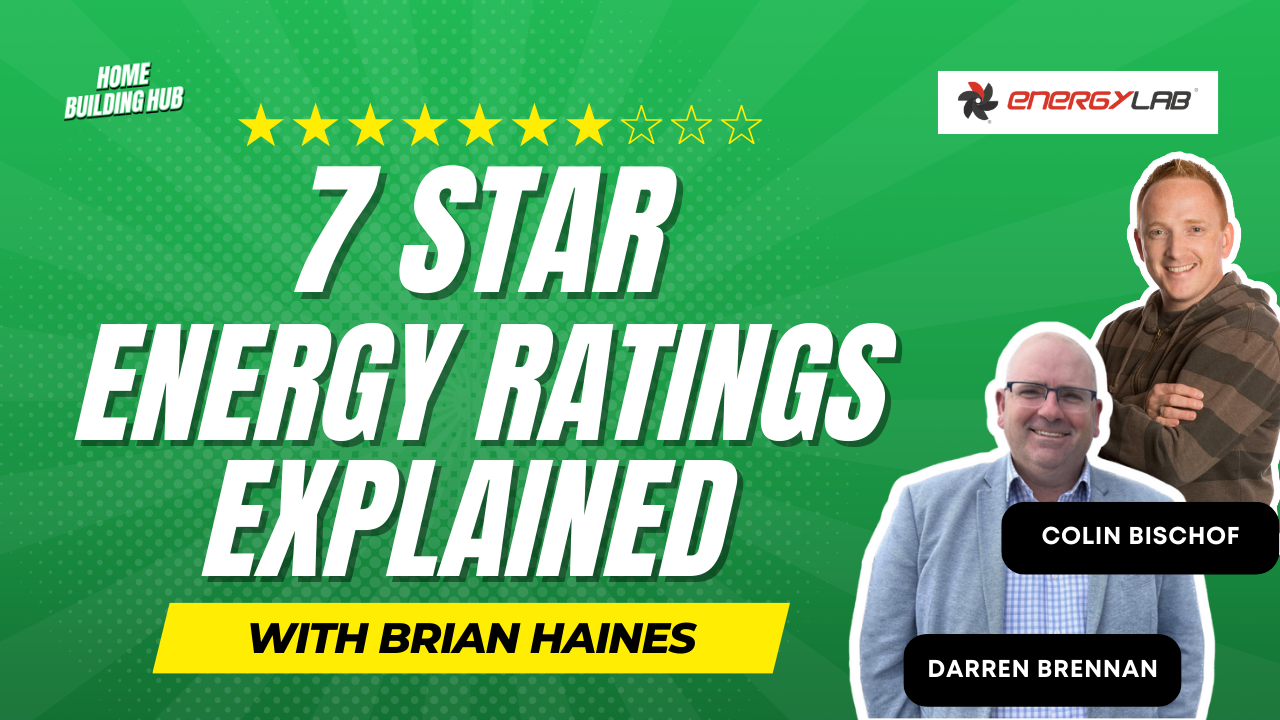

Join us in this enlightening episode as we delve into the world of energy ratings and sustainable living. We kick off by introducing AI and machine learning into energy ratings, paving the way for a greener future. Discover the ins and outs of NatHERS (Nationwide House Energy Rating Scheme) and what it takes to achieve a coveted 7-Star rating. Explore the key design elements impacted by these changes, and learn how land orientation and neighboring houses can influence your home's price. We also discuss the shift from 6-Star to 7-Star requirements, the associated costs, and the 'whole of home' perspective. Plus, we address whether now is the time to buy to avoid the new requirements and explore alternative materials for achieving higher energy ratings.
Watch full episodeFrequently asked
What is NatHERS and why does it matter for Adelaide?+
NatHERS (Nationwide House Energy Rating Scheme) rates a home's thermal performance from 0 to 10 stars. Since May 2024 every new home in SA must achieve minimum 7 stars. Higher stars = less heating and cooling energy required. Adelaide's hot dry summers and cool wet winters make thermal performance particularly valuable - a 7-star Adelaide home uses roughly 60% less heating/cooling energy than a pre-2010 conventional build.
What is Passive House and is it worth the premium?+
Passive House (Passivhaus) is a German-origin ultra-low-energy building standard - typically 9-10 star NatHERS equivalent. Certified Passive House requires very high insulation, continuous airtight membrane, mechanical heat-recovery ventilation, and blower-door testing to 0.6 ACH50. Premium is $700-$1,200+ per m² above conventional. Worth it if you value near-zero heating/cooling bills, exceptional indoor air quality, and 40+ year building resilience. Payback is 12-18 years on energy alone but faster including health / comfort value.
Do sustainable builds attract any SA grants or rebates?+
Yes - the SA Government offers a Home Battery Scheme rebate (up to $2,000 per household on battery installation) and the Retailer Energy Productivity Scheme (REPS) subsidises certain energy-efficient appliance installations. Federal incentives include the Small-scale Renewable Energy Scheme (STCs) for solar and hot water. Total combined grant / rebate value on a well-planned sustainable build is $6k-$14k in 2026.
Note: the stories below are Adelaide-based clients - the underlying builder-matching process is identical for Melbourne buyers.
How our process runs - real client stories
Federuzzi Development
Two double-garage homes squeezed onto an odd-shaped subdivision block in Ingle Farm, with the equity earmarked to fund the next development.
Read the case studySterai Residence
A practical, well-planned knockdown rebuild on a tricky triangular block in Ingle Farm.
Read the case studyKeep reading
Related guides
Custom Builder Adelaide
For fully-bespoke NatHERS-tuned designs
Read guideSustainable Home Builder Melbourne
Reciprocal Melbourne guide
Read guideAdelaide Build Cost 2026
Land + build + site + statutory - a data-anchored breakdown
Read guideWhich Builder Should I Choose?
The three-tier decision framework Adelaide buyers actually need
Read guide