What to Look for in a Dual Occupancy Builder in Melbourne
Dual occupancy is two dwellings on one lot, assessed under Clause 55 of the Victoria Planning Provisions. Melbourne middle-ring suburbs deliver most Vic dual-occ development. Vetting focus: Clause 55 track record, subdivision coordination, tandem vs side-by-side design experience.

Find your Melbourne builder in 60 seconds
Tell us your build type and budget and we'll match you with vetted Victorian builders that fit your block and brief.
Free · no obligation · builders contact you, never the other way around.
Framework
Clause 55
two-or-more-dwellings on a lot
Typical size
2 × 180-220m²
two full 3-4 bed homes
Cost band
$1.4m-$2.4m
both dwellings 2026
Duration
18-26 months
design + construction
The vetting checklist that applies to every Melbourne specialist
BuildPilot does not yet match Melbourne builders. Until we do, this is the vetting method we would use ourselves. The first five checks below are specialist-specific; the rest are the core VBA + VMIA + ASIC checks that apply to every domestic builder working in Victoria.
- Ask their Clause 55 approval track record - dual occ needs the harder ResCode Standards under Clause 55 not the simpler Clause 54
- Ask if they coordinate subdivision surveyor + Owners Corporation setup - the answer separates full-service dual-occ specialists from generalists
- Ask about tandem vs side-by-side experience - the two plan patterns have very different site-planning challenges
- Ask about interim staging - some dual-occ builds sequence one dwelling to Occupancy Permit first while the second progresses
- Verify current VBA registration and category on the public register at vba.vic.gov.au/practitioners/register
- Verify no active or recent disciplinary decisions on the VBA disciplinary decisions list
- Confirm Domestic Building Insurance (DBI) will be issued in the builder's name for your contract price under VMIA (all residential work over $16,000)
- Search the ABN on abr.business.gov.au - name, GST status, date of registration
- Confirm the entity is not under external administration on the ASIC register
Tandem vs side-by-side dual occupancy
Tandem dual occ (rear dwelling accessed by a shared driveway easement) suits deep, narrow lots - 500-700m² with 12-15m frontage. Side-by-side dual occ suits wider lots - 700-900m² with 18m+ frontage. Tandem plans typically deliver more private open space for the rear dwelling; side-by-side plans deliver equal streetscape presence. Each has different Clause 55 challenges.
The four red flags that end the conversation
These four signals correlate strongly with builders who have failed or entered administration in Victoria in the last three years. Any of them = walk away.
- Requested deposit exceeds 10% of contract value (Victorian DBC Act caps deposits at 5%)
- Vague or evasive answer on DBI eligibility for your specific contract price
- Refusal to name the Registered Building Surveyor or to let you speak to them independently
- Aggressive time-limited discount contingent on paying deposit before you have read the contract
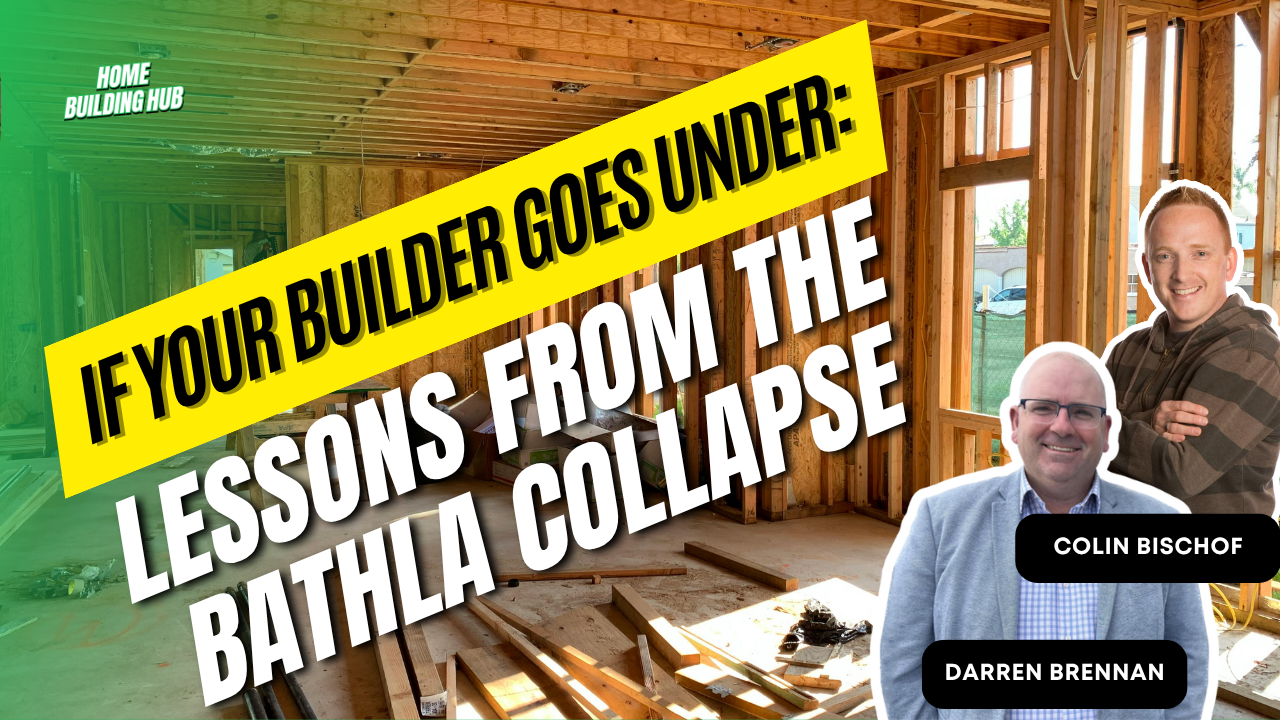

The collapse of Bathla Group has left thousands of buyers facing uncertainty and raises an important question for anyone building a home: what actually happens if your builder goes under? In this episode, we explain the critical differences between a developer collapse and a builder collapse, how Victoria's new Home Warranty scheme works, and the practical steps every homeowner can take to protect themselves.
Watch full episodeFrequently asked
Do I need subdivision to sell one of the dual-occupancy dwellings?+
Yes. Sale of individual dwellings requires either full plan of subdivision (creating two separate titles) or Owners Corporation (strata) subdivision. Both are separate Planning applications after or alongside the building Planning Permit.
Which Melbourne councils are dual-occ friendly?+
Historically Monash, Kingston, Whitehorse, Manningham and Boroondara have been active dual-occ councils. 2023 planning reforms have opened more paths in inner and middle-ring councils. Check the specific council's Local Policy for dual occupancy.
What is a "battle-axe" dual occupancy?+
Rear dwelling accessed by a narrow "handle" driveway across the front lot. Battle-axe is the classic tandem pattern. It requires a right of carriageway easement on title and a specific driveway width standard (usually 3m+).
Can I build dual occupancy in a Heritage Overlay?+
Difficult. HO usually requires the front dwelling to preserve heritage form. Rear dwelling is often possible if not visible from the street. Every case needs a Heritage Impact Statement.
Note: the stories below are Adelaide-based clients - the underlying builder-matching process is identical for Melbourne buyers.
How our process runs - real client stories
Federuzzi Development
Two double-garage homes squeezed onto an odd-shaped subdivision block in Ingle Farm, with the equity earmarked to fund the next development.
Read the case studySterai Residence
A practical, well-planned knockdown rebuild on a tricky triangular block in Ingle Farm.
Read the case studyBuilding in Adelaide instead?
Read our Adelaide equivalent